
| Some data advice from Sir John Hegarty |
| You can’t eat soup with a fork. You shouldn’t hammer in a screw. And those who bring a knife to a gunfight find themselves at a severe disadvantage. Selecting the wrong tool for the job usually delivers poor results. It’s perilous too. There’s a section on the subject to be found in a safety handbook produced by the US Navy. It cautions against things like using a chair where a ladder is necessary, or a knife when you need a screwdriver. There’s more jeopardy associated with these things at sea – but this sort of thing is still cavalier on land. The physical examples are absurd. But in the digital sphere, we’re a lot more lenient when it comes to selecting the incorrect tackle. The worst offenders are those who obsess over the power of data – specifically, its ability to predict and measure things that were unmeasurable before. Research and evidence are fundamentally important, but we’re so enchanted with the capabilities of data that it’s started to feel like we can’t come to a decision without the reassurance of a stat. This is a problem – an emphasis on what’s been prevent the imagining of what might be. Data never invented anythingAmidst all the talk of data-driven businesses, the greatest commercial achievements of recent decades have had surprisingly little to do with it. Consider the most successful product from the (until recently) biggest company in the world – Apple’s iPhone. The story of its conception involved a handful of envelope-pushing tech executives drawing on their knowledge of the consumer, and the creative capacity of their development teams. Data took a back seat to human insight. This is the case with almost every brilliant product that we deem indispensable in 2024. James Dyson’s bagless vacuum cleaner, Elon Musk’s car company, Bill Bowerman’s running shoe. These contributions to our civilisation came from imagination. Data informs, creativity inspiresThe same is true in marketing and brand-building. Data becomes useful to businesses when it exposes a truth. As I’ve often said, when an idea possesses that quality, it becomes powerful. Uncovering a fact might spark the creative engine, but that isn’t enough. It takes empathy, intuition and perseverance to bring off a campaign around it. The great brand campaigns of the last twenty years are all built around truth, whether that authenticity is drawn from a data point or not matters less than most digital zealots would have us believe. A debate is raging when it comes to how AI will impact creativity and business. More tools don’t always result in better outcomes, but as they proliferate the best entrepreneurs – like the best carpenters – will know which ones to pick up, and which ones to leave on the bench. |
Advertising
Aimed at the stars

Faced with the threat from it’s online competitors, Click&Go Holidays identified a critical disparity. While rivals boasted expansive online reach and ample budgets, their failure to deliver on promised customer service and comprehensive holiday offerings left dissatisfied customers in their wake.
Moreover, their actions tarnished the online travel industry’s reputation, prompting a necessary intervention. In contrast, Click&Go proudly upheld its status as Ireland’s favoured online travel company, backed by an exceptional Trustpilot rating.
To highlight this advantage, we devised a campaign leveraging the company’s 5-star Trustpilot rating. Through visually striking, impactful creatives, the campaign not only reassured Click&Go’s clientele but also sowed seeds of doubt among those considering other online platforms for holiday bookings.
The creative executions allowed us to showcase aspirational locations, and are flexible enough to work across all the different types of holidays that Click&Go offer.
This campaign marked a notable departure for us due to budget constraints, making traditional photography and stock images impractical options. In response, we generated these visuals initially within Mid Journey, refining them further in Adobe Photoshop using the software’s dedicated Generative AI plugin.
The campaign is due to run during Q1 and will be on all of Clic&Go’s social media channels as well as online display and VOD.







Guinness Sufer 25 years on

Is there anything like this on an ad break anymore? An iconic piece of advertising history that is often cited as an example of storytelling and emotional impact in marketing. A review of the Guinness “Surfer” ad 25 years on…
https://lnkd.in/ewKnkET8
https://creative.salon/articles/features/guinness-surfer-learnings-qotw

Digital Out of Home – Are we being creative enough?
If you ask any creative they would say Outdoor, as I still call it or Out Of Home (OOH) as it is now called, is one of their favourite mediums. You’ll see any creative go weak at the knees at the prospect of creating an outdoor campaign. Why? Well this is high impact format that challenges us to think clearly, simply and distinctly. To convey a message that has to engage and be memorable in a few brief seconds. It often said in the business that if your idea works in outdoor it will work in any other medium.
OOH is evolving, it now embraces technology, hence the term Digital Out Of Home (DOOH). It is no longer just the static medium it once was. Technology has given it new life. For good or bad this has presented us with new and exciting challenges. I believe this brings us opportunities to create new and brilliant creative work and I also believe that the full potential of medium has not been fully realised in this market.
I’m sometimes disappointed to see DOOH sites regurgitating the print version of ads on digital screens or using 10 second cut downs of a TV ad that been retrofitted onto a DPOD.
By using DOOH like this, it feels like it is being used as an afterthought just to fill a space or to backup a campaign that was designed for other media. Surely we can do much better than wasting money and wasting opportunities for brands to have greater engagement and impact with their audiences?
DOOH now utilises a whole range of technologies, it’s a very rich medium. It can use motion tracking, heat sensing, facial and voice recognition, AI, AR, VR, video streaming and contactless payments. It can use real time data such as weather, time, traffic and shopping transactions. Messages can be updated in real time and geo-targeted. Or it can can display using something as simple as the humble gif. It’s integration with mobile give us countless opportunities to engage with audiences from sharing photos, dispensing products and vouchers to live streaming.
There are some great examples of creative and innovative DOOH from around the world, from the very simple to the more complex. Some of these use existing technology while others have had the tech specially created for them. This trend has been reflected in the past couple years at the Cannes Lions were it has its very own innovation category.
DOOH definitely involves more work than traditional OHH, particular on the technical side. I would not expect every person to be a technologist, but it always pays to keep your finger in the pulse with latest goings on in technology. It might be an obvious thing to say, It’s like any creative process, enjoy the challenge, have fun doing it, learn on the way and you won’t go far wrong.
My tips for working in DOOH.
The most important thing is still the idea:
No matter how good the technology is, if you do not have a good idea, it’s not going to work. It’s all well and good announcing you are first to market with new technology but if your idea is not engaging with your audience with a relevant message you are polishing a turd.
Research the technology:
You are not expected to know the exact detail of every piece of technology that available in DOOH. But keeping your finger on the pulse and researching what’s out there and helps you stay informed about what you can and cannot do. Collaborating with technologists, media specialists and outdoor suppliers at the earliest opportunity is very important. It will help them feel as part owners of the execution and get them excited about the project. There are people you can talk to in JCDecaux, PML and Exterion Media who all want to help. They all want good work on their showreels too. This will also reassure the client that you have done your homework and you know what you are talking about.
Stress test it over and over again:
We can sometimes get over enthusiastic about a piece of technology and loose the run of ourselves particularly when we get bogged down at ideation stage. I often find when tapping to the minds of technical people their enthusiasm naturally runs away with them and they go in to ‘nerd’ mode. It’s important to stop, check and remember to put yourself in to the shoes of who your talking too. The last thing on people’s mind as they go about their lives is your ad. Stress test the technology, and ask yourself will it engage your audience? If you are asking them to download an app – will they? Be your own worst critic. If it doesn’t work, make it simpler or bin it.
Location Location:
DOOH sites are now in a variety of locations, from roadsides to inside shopping malls. It’s vitally important to know where the location of your sites are and what your audience will be doing in those locations. There’s no point asking your audience to engage their mobile phones on a site next to major road.
Invent it yourself (or get someone too)
Sometimes you maybe fortunate to come up with an idea that involves creating a piece of technology that doesn’t yet exist. There is no harm pushing the boundaries of what can be done. With risk comes reward. The idea might be quite nebulous in your head, but this were research comes in again and finding the right people that will help it come to fruition. It’s the nature of tech people to love a challenge and they will generally pulls out all the stops to create something groundbreaking. At worst they’ll be honest and say they can’t make it happen. At least you’ll know where you stand before presenting it to the client. Take look in the area of tech start-ups and university labs, you might find the answer in the basement of Trinity College.
Examples of DOOH
Apotek Hjartat Blowing in the wind
HTTPS://VIMEO.COM/264556996
Women’s Aid #lookatme campaign
https://vimeo.com/122550922
British Airways – Magic of Flying
https://vimeo.com/122826929
Jetstar Dream Holiday Eye Tracking
https://www.youtube.com/watch?time_continue=52&v=ppC6Qh4CT4A
Mega shark attack at Southern Cross Station
https://www.youtube.com/watch?v=OjoMM7NvFog
Coca Cola – Bringing India & Pakistan Together
https://www.youtube.com/watch?v=ts_4vOUDImE
Norwegian Centre against Racism
https://www.youtube.com/watch?v=ijUYmOWlTZI
Netflix gifs Campaign
I love how clever and simple this campaign for Netflix is.
https://www.youtube.com/watch?v=gBy2Tz_pmKA
SWEDEN. WHERE GREAT HAPPENS (SOMETIMES)
There’s a wonderful attitude that permeates Swedish culture where there is a deep respect and enthusiasm for people who are bold and creative. Whether that is in engineering, science or the arts.
But they don’t seem to shout about it. They just seem to quietly get on with it and go off and create stuff and yet be hugely successful at it.
We can see this reflected in how much the Swedes have influenced the rest of the world. Of course, there was ABBA and where would we be without IKEA? Or premier car brands like Volvo and SAAB. H&M, handy for those Hawaiian shirts. Countless Nordic Noir TV shows like The Bridge and Wallander.
This quiet success appears to be happening in the advertising industry in Sweden, particularly in the last 10 years. Since I’ve been in the digital side of the business I have become very aware of their work. They were early adopters of digital and have constantly produced world class ground breaking work using technology to tell engaging brand stories.
We now see several Swedish agencies opening networks around the globe. All this from a relatively small market of 10 million people. Just this week arguably Sweden’s most creative agency Forsman Bordenfors has merged with KBS creating a new worldwide agency network.
Last week IAPI hosted Åkestam Holst, Magnus Jakobsson, one of Sweden’s most awarded Creative Directors and Karl Wikstrom, Senior Strategy Director. They talked about their working methods and spotlighted some of their most innovative campaigns. Interestingly none of the examples they presented were in traditional mediums and all of them used original thinking combined with innovative technology.
They spoke openly about their agency’s working model and how they believe they create such great work by investing in great people.
Three key rules for Åkestam Holst:
- Have no hierarchies
- Invite every creative to every brief
- Apply next level niceness
These three beliefs lead to a workplace where everybody has an opportunity to contribute, a great idea can develop from anywhere and people have the freedom to fail. With equality, humility and hard work – anything is possible.
They talked about their 10 principles and used example campaigns to highlight how they put them to good use.
- It’s a cliche but be brave.
- Tell the stories no-one else is telling.
- Attempt the unattempted – just because.
- Don’t think campaigns. Think creative eco-systems.
- Let people be themselves.
- Listen to science but don’t let science run the show.
- Smash taboos.
- Create the safety to be brave.
- Think of technology as a medium.
- Create long ideas for a global audience.
HTTPS://VIMEO.COM/267985113 Reporters without billboards
HTTPS://VIMEO.COM/264641574 IKEA where life happens
HTTPS://VIMEO.COM/277079056 Social Beer
HTTPS://VIMEO.COM/264609191 Human Metal
HTTPS://VIMEO.COM/264644915 Voice of Change
HTTPS://VIMEO.COM/264643780 IKEA Pee Ad
HTTPS://VIMEO.COM/193364630 SAS we are Travellers
HTTPS://VIMEO.COM/264644904 Audio Safety code
HTTPS://VIMEO.COM/264607412 Apotek Hjartat Coughing Billboard
HTTPS://VIMEO.COM/264556996 Apotek Hjartat Blowing in the wind
They rounded off their presentation highlighting how Åkestam Holst aim to create genuinely exciting ideas, that are well executed, cleverly distributed and tell a bigger story. To them, that’s creating good. If you take a chance on brave and bold ideas some will succeed, some will fail, but that’s why they say “Sweden is Where Great Happens (Sometimes…)”
Of course with typical modesty they then challenged us to go out there and beat Sweden at Cannes next year.
Lycka till.
John Martin
Rise of the Bots
Being Human
At the start of the new year I thought it would be a good idea to have a look at recent and interesting developments, particularly in area of AI.
If you have been following the TV series Westworld, in one particular episode, two of the main characters are in deep conversation about the original concept behind the Westworld theme park. From the parks foundation, the developers tried to find out how to get the Hosts (Robots) to come across as being ‘more human’, in order to offer a better experience for the guests. Of course they found the best way was for them to learn was to interact with humans.
The hosts were then programmed to learn all the nuances, flaws, doubts, and emotions that make up being human. It wasn’t just about replicating human intelligence but human unintelligence. This in turn made them appear more human, so over time the guests at the park couldn’t tell the difference between the humans and the hosts. Hence the hosts had passed the Turing Test.
The Turing Test
The Turing Test is named after the mathematician Alan Turing and is a test for behavioural intelligence in a computer, requiring that a human being should be unable to distinguish the machine from another human being by using the replies to questions put to both.
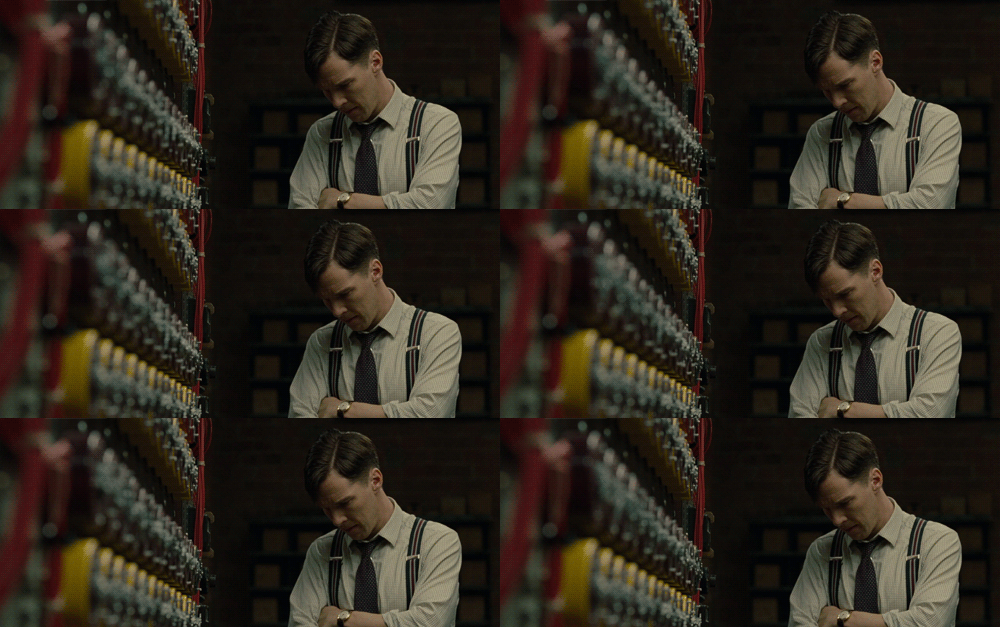
In a way what is happening in the world of Westworld is happening right now – we’re not actually building sentient robots yet, but it’s getting there.
Little Critters
This year in particular we have seen the rise of the ‘Bot’ or ‘Chatbot’. These little critters are popping up rapidly on the messenger apps like Facebook Messenger, Kik, Wechat and Slack. They are being churned out at a rate of knots by over excited developers with over 11,000 out there and rising.
Nearly all the messenger apps are starting to invest heavily in the development of chatbots and are actively encouraging and challenging developers to take on chatbot projects and build their own. To make life easier for developers they are even offering ready made templates to get them started. The enthusiasm has been infectious and some brands have already been early adopters of the technology and have started to communicate and sell products and services to their customers via a chatbot.
Exciting times

So why get all excited about chatbots? Well with more and more people using messaging apps than ever before, from a marketing point of view this is game changer. Anyone on a messenger app can now have a one on one conversation with a product, service or brand that uses a bot. With up to 2.5 billion people using messenger apps and growing it’s a massive audience and younger audiences are using message apps more than social media.
There are now bots for news, games, weather, fashion, booking holidays, financial advice and shopping. There’s even an influencer bot – so the human influencers had better watch out! There’s even a bot that can be your friend in case you have no human friends, the less said about that one the better.
Bots are not just being developed for messenger apps but for Smart Devices such as Google Assistant, Apple Siri and Amazon Echo. Where the conversations are not limited to text but in audio and using voice recognition. Mark Zuckerberg recently showcased Facebook’s Jarvis project in his own home. Google setup ‘Google Brain’ 5 years ago and are actively pursuing an AI agenda, particularly applying from what they have learnt from the development of Google Translate. Audi and Honda are also in the early stages of developing a bot for your car, or rather your car is a bot – think Knight Rider!
It’s trial and error and developers will admit they are on a very steep learning curve about getting the user experience right. In a lot of cases the conversations usually are basic, linear and structured with a very obvious list of pre-programmed questions and answers. That maybe the fault of some of the template options available. There are some bots out there were more thought has gone into giving them a bit of personality and therefore the conversation with humans appears more natural. Just interacting with a bot you get a good idea where this technology is going.
The challenge from a brand point of view, is to create bots that will engage with customers on a conversational level, to be more of helpful and natural rather than trying to ‘robotically’ sell to you. This may sound easy, but it can be quite a challenge for creatives and developers to get the balance right in the brand bot / human relationship to create a good user experience.
However like Westworld, bot developers will tell you their long term plan is to have bots learn from interacting with humans (machine learning) and therefore appear more human and therefore create a better user experience.
Such is the rate of development, within 5 years you could chat with a messenger bot like you would with anyone of your friends or family, it will have a conversation with you based on your relationship with it. That conversation would have all the bonding, banter, slang, humour, and nuances that are involved in any dialogue between two people who know each other.
How people may feel about this kind of relationship and how it could be misused remains to be seen.
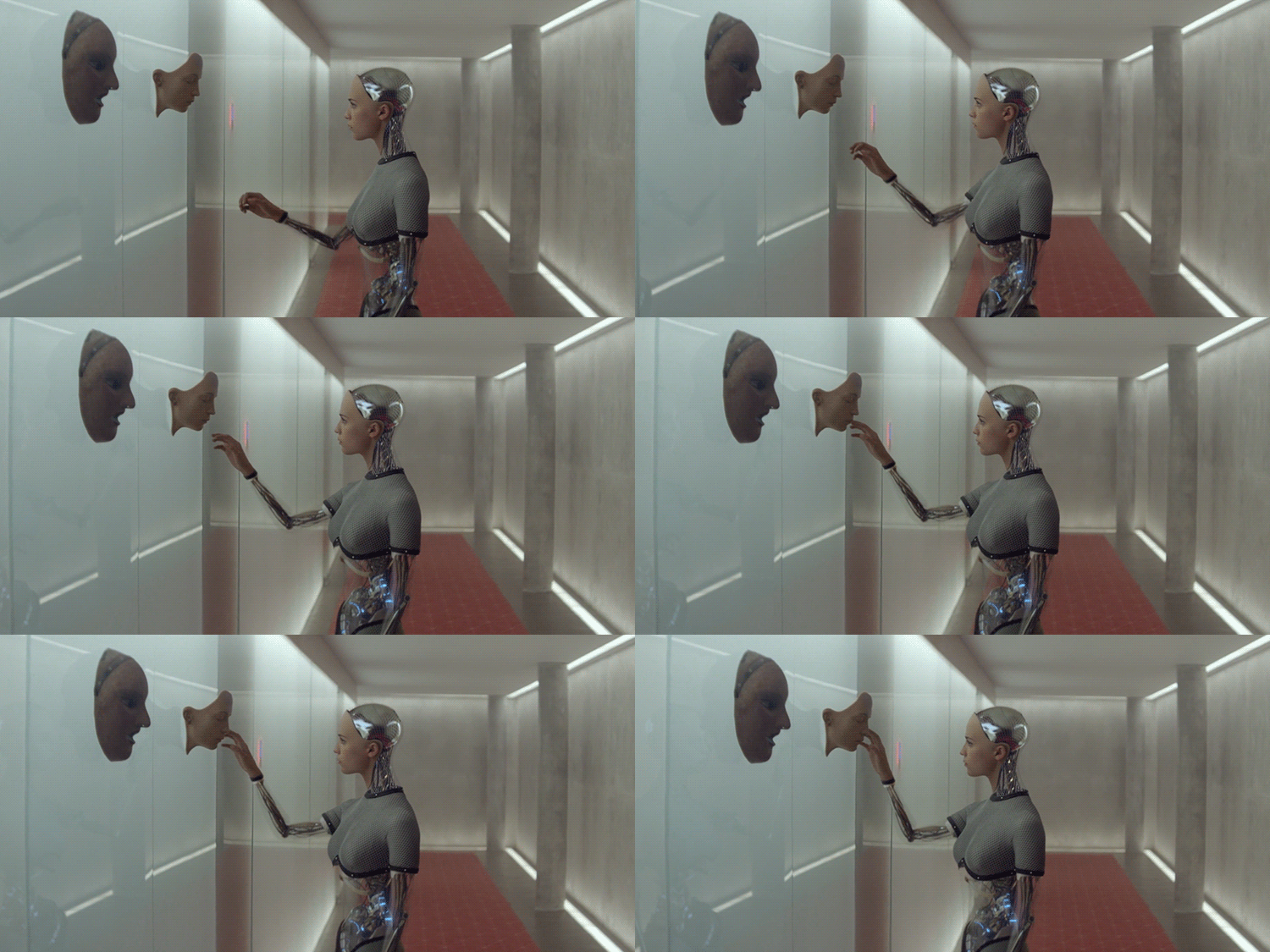
The development and application of this technology appear to be limitless and will have implications across business, politics and society. Experts have been talking about the fourth, (or fifth) industrial revolution, or the third wave of globalisation.
Maybe it’s ironic that the first AI to pass the Turing Test will be from a messenger app bot or from a smart device and not a supercomputer or Android. It looks like 2017 could be the year we see the rise of the bots.
Storytelling with Technology
Advertising has always tried to embrace the latest technology. Harking back to the early days of print, followed by the advent of radio and television.
However, early executions of these mediums often came up short. Many thought by having a brand advertising on these mediums it was enough to dazzle their audience.
In the late 1950’s there was a great deal of confusion on how best to advertise on television. Just have a look at the first ever TV ad broadcast in the UK and you’ll see how random and laboured the messaging was.
https://www.youtube.com/watch?v=-g0P_ETSwko
Lessons were quickly learned, having your brand on the latest piece of technology was not enough. The audience may have been captivated by technology alone initially, but the novelty of it had quickly worn off, the message wasn’t getting across. It was time to get creative and use these new mediums to their best ability, to connect and engage with this new audience, appeal to their motivations and desires to tell brand stories.
What followed was an era of great print, radio and television advertising from the 1960’s to the 1990’s. Ads became more simple, more singular in their messaging, there was still a lot of rubbish. But the good work was really good.
Of course, along came – the internet, and that changed everything. In our ever-changing digital world, the audience is much more fragmented, more mobile and has shorter attention spans. Consumers are adopting technology at a much faster pace and it’s not slowing down.
There is more pressure than ever for us to adopt and innovate, as advertising and technology businesses are more closely aligned than ever. In a lot of cases advertising has merged with or set-up innovation companies with the sole purpose of developing new technology to market brands.
Now when a new piece of technology comes along it’s followed by a great deal of hype and excitement – it’s the new kid on the block, it’s the flavour of the month, the talk of the town and there is huge pressure to attach a brand to it.
While it may be exciting to be an early adopter or first to market with some of these innovations, it’s important to do it for the right reasons. Some brands are scrambling to use the latest technology with little or no brand story. Yes, some of the technology is impressive, but does the audience recognise what the brand is trying to say?
As practitioners it’s up to us to find the best way to communicate the brand story to our audience, whether it’s using ink, data capture or virtual reality to make sure they are engaged with that story. Technology should enable the story, not be the story.
Of course technology will keep evolving and we will endeavour to keep up. However our audience will not change. They will still be human, will all that entails, with real lives, motivations and desires, ready to be told a story.
At ICAN, we do our utmost to be up to date with the latest technologies, and figure out how to apply them in a meaningful way to the brands we work with. This is a very different process to traditional advertising and often involves keeping our fingers on the pulse with the latest innovations. A great deal of time is spent researching, testing and even physically acquiring the technology to just to mess around with it to find its strengths and weaknesses.
We did just this in two recent projects. Collaborating heavily with our technology partners, we stress tested each piece of technology, questioned their developers about any potential pitfalls. Most importantly of all, educated them on what we would like it to do for the brand.
Tennents Lager was long associated with the music scene. However it’s target audience was now a younger digitally savvy audience, who are gradually tuning out of traditional advertising, but consuming more and more content via their mobile phone.
We researched heavily what piece of technology would be suitable to answer the client’s brief, yet engage this audience. The result was Tunetap, a web responsive mobile app that acted like a jukebox in music bars and clubs.
Tunetap events were advertised and users were encouraged to use the app with prizes embedded in the music playlists.
permanent tsb wanted to engaged with the house hunter audience and associate it’s simple mortgage process with a piece of technology that would help house hunters find a home and reinforce its proposition that they were an ally to their customer.
We discovered that the Periscope App was ideal for the task. It provided house hunters who were too busy to visit every home with a tool to view properties they were interested in via their mobile.
We partnered with estate agents to carry out viewings through the app to a mobile audience. Each viewing was broadcast live on social media, then uploaded to a video hub on partner publisher.
If you’re interested in some more recent international work that utilises new technology to tell brand stories, check this great work out!
NETFLIX – Socks
https://www.youtube.com/watch?v=Fi6RLrJrjLQ
Pepsi – Unbelievable bus shelter
https://www.youtube.com/watch?v=Go9rf9GmYpM
Lockheed Martin – Field Trip to Mars
https://www.youtube.com/watch?v=CWClyQkA32s
Peruvian red Cross – hashtag for life
https://www.youtube.com/watch?v=-x56ss54WZs
ING – The Next Rembrandt
https://www.nextrembrandt.com/
Currys – Christmas Hints
http://www.canneslionsarchive.com/winners/entry/781289/hints
BEATS BY DRE – Straight Out Compton
https://www.youtube.com/watch?v=RyDJNZH2kWo
Samsung – Blind Cap
https://www.youtube.com/watch?v=8caXvQpWFeo
Theraflu – thermoscanner
https://www.youtube.com/watch?v=mK7tioG-Rg4
Perception, a reality check
A few years ago on a cold January morning during rush hour a man walked in to a metro station in Washington DC. He was carrying a violin case. He stopped near the enterance were hundreds of busy commuters were being channeled in and out of the station.
He opened the violin case, took out the violin and carefully placed the open case at his feet in front of him.
Over the course of an hour he played six of the most complex and intricate pieces of classical music ever written.
“Chaconne” Partita No. 2 in D Minor Johann Sebastian Bach
“Ave Maria” Franz Schubert
“Estrellita,” Manuel Ponce
“Meditation de Thais” Jules Massenet
“dour Violin Concerto in G Minor” Max Bruch
“Chaconne” (reprise) Johann Sebastian Bach
During that time’ six people stopped and listened’ including a young boy who force his mother to stop in her tracks.
A few more people tossed coins and notes as the quickly passed by. Once he was finished he packed away his violin and left the station with the $32 dollars he had collected in his case.
The man was Joshua Bell, one of the world’s finest classical musicians. He played each piece on a three hundred year old Stradivarius valued at 3.5 million dollars. A week earlier in Boston’s Symphony Hall, the cheapest seats at his concert cost $100.
This was an exercise sponsored by the Washington Post in to studying perception, priorities and awareness of people going about their daily lives.
It reminds us of how people are so wrapped up in the own lives and how little they take notice of the world around them. It’s also a reminder how difficult it is to interrupt our audience from whatever else they are doing and engage with them.
If six musical masterpieces played to perfection by Joshua Bell can only stop a few people in their tracks and out of their everyday routine, imagine how good your advertising has to be?
The Eureka Moment
As a creative person working in an ideas business an important part of the job is to sit down, either on your own or with a colleague, and try to crack a brief to find that illusive idea or insight.
Most of us know the story. After many hours or days of stress and perspiration something happens. You go off take a break and do something completely different or just stare out the window. Then the answer for no apparent reason enters you head. You know it feels right, it feels good, and it’s the answer you have been looking for. A rush of euphoria and an aura of invincibility usually follow this Eureka moment.
It’s a mental process that most of us haven’t thought too much about. However, I was struck by an article by American Neuroscientist Jonah Lehrer who was promoting his latest book ‘Imagine: How Creativity Works’. He thinks about this stuff a lot.
Lehrer is a bit of a genius. He’s only 32, he’s a Rhodes Scholar and has already written three books on Neuroscience. He’s a contributing editor to Wired Magazine and to the New Yorker Magazine. He frequently lectures around the world too.
Now if you’re thinking John has gone off on one of his science benders please bear with me. Lehrer is just casting a bit of light on something we do everyday. So I thought I’d share it.
He believes there are number of factors in us arriving at a moment creative insight or idea. He backs this up with anecdotal evidence and experiments from the science lab. He uses a simple example of how our brain works coming up with an idea. It is called Compound Remote Association Problem – CRAP for short. In the video in the link below he asks the audience a CRAP problem.
Experiments have shown that during this process of Compound Remote Association Problem our brain uses same patterns when we go through the brainstorming process to arrive at an idea or insight. These brain patterns or waves are called Alpha waves.
We produce the most Alpha waves when we‘re relaxed and calm, or simply daydreaming.
Bob Dylan wrote his best music when he decided to quit the music business. Einstein came up with the theory of relativity while staring out the patents office window daydreaming. And Isaac Newton took long walks in his garden while mulling over gravity.
So, daydreaming is good.
However Lehrer is not saying we should all go out, lie in the grass, and chill out. The moment of insight usually follows a lot of hard work and is followed by more hard work. ‘Grit’ as he calls it.
Lehrer describes Grit as being single-minded in our focus to succeed and our willingness to learn from failure. Great ideas are still 99% perspiration and 1% inspiration.
http://player.vimeo.com/video/45162748
If you’re engaged by all this stuff you can also read about how experience and environment also affect the way we come up with ideas. Some of the examples he uses in this area seem to contradict his observations about being relaxed and calm. Moments of extreme stress, like a life and death situation can result in an insight.
He has been accused by other Neuroscientists of trying to simplify how the mind works. They point out many processes of the mind are still a mystery and undefined.
I have highlighted the area that is of most relevant to us. But if you want to know more you can read and see a bit more of him in action on the links below. Or, if you’re really impressed you can buy the books.
 Art Director Nerd