
| Some data advice from Sir John Hegarty |
| You can’t eat soup with a fork. You shouldn’t hammer in a screw. And those who bring a knife to a gunfight find themselves at a severe disadvantage. Selecting the wrong tool for the job usually delivers poor results. It’s perilous too. There’s a section on the subject to be found in a safety handbook produced by the US Navy. It cautions against things like using a chair where a ladder is necessary, or a knife when you need a screwdriver. There’s more jeopardy associated with these things at sea – but this sort of thing is still cavalier on land. The physical examples are absurd. But in the digital sphere, we’re a lot more lenient when it comes to selecting the incorrect tackle. The worst offenders are those who obsess over the power of data – specifically, its ability to predict and measure things that were unmeasurable before. Research and evidence are fundamentally important, but we’re so enchanted with the capabilities of data that it’s started to feel like we can’t come to a decision without the reassurance of a stat. This is a problem – an emphasis on what’s been prevent the imagining of what might be. Data never invented anythingAmidst all the talk of data-driven businesses, the greatest commercial achievements of recent decades have had surprisingly little to do with it. Consider the most successful product from the (until recently) biggest company in the world – Apple’s iPhone. The story of its conception involved a handful of envelope-pushing tech executives drawing on their knowledge of the consumer, and the creative capacity of their development teams. Data took a back seat to human insight. This is the case with almost every brilliant product that we deem indispensable in 2024. James Dyson’s bagless vacuum cleaner, Elon Musk’s car company, Bill Bowerman’s running shoe. These contributions to our civilisation came from imagination. Data informs, creativity inspiresThe same is true in marketing and brand-building. Data becomes useful to businesses when it exposes a truth. As I’ve often said, when an idea possesses that quality, it becomes powerful. Uncovering a fact might spark the creative engine, but that isn’t enough. It takes empathy, intuition and perseverance to bring off a campaign around it. The great brand campaigns of the last twenty years are all built around truth, whether that authenticity is drawn from a data point or not matters less than most digital zealots would have us believe. A debate is raging when it comes to how AI will impact creativity and business. More tools don’t always result in better outcomes, but as they proliferate the best entrepreneurs – like the best carpenters – will know which ones to pick up, and which ones to leave on the bench. |
bots
Rise of the Bots
Being Human
At the start of the new year I thought it would be a good idea to have a look at recent and interesting developments, particularly in area of AI.
If you have been following the TV series Westworld, in one particular episode, two of the main characters are in deep conversation about the original concept behind the Westworld theme park. From the parks foundation, the developers tried to find out how to get the Hosts (Robots) to come across as being ‘more human’, in order to offer a better experience for the guests. Of course they found the best way was for them to learn was to interact with humans.
The hosts were then programmed to learn all the nuances, flaws, doubts, and emotions that make up being human. It wasn’t just about replicating human intelligence but human unintelligence. This in turn made them appear more human, so over time the guests at the park couldn’t tell the difference between the humans and the hosts. Hence the hosts had passed the Turing Test.
The Turing Test
The Turing Test is named after the mathematician Alan Turing and is a test for behavioural intelligence in a computer, requiring that a human being should be unable to distinguish the machine from another human being by using the replies to questions put to both.
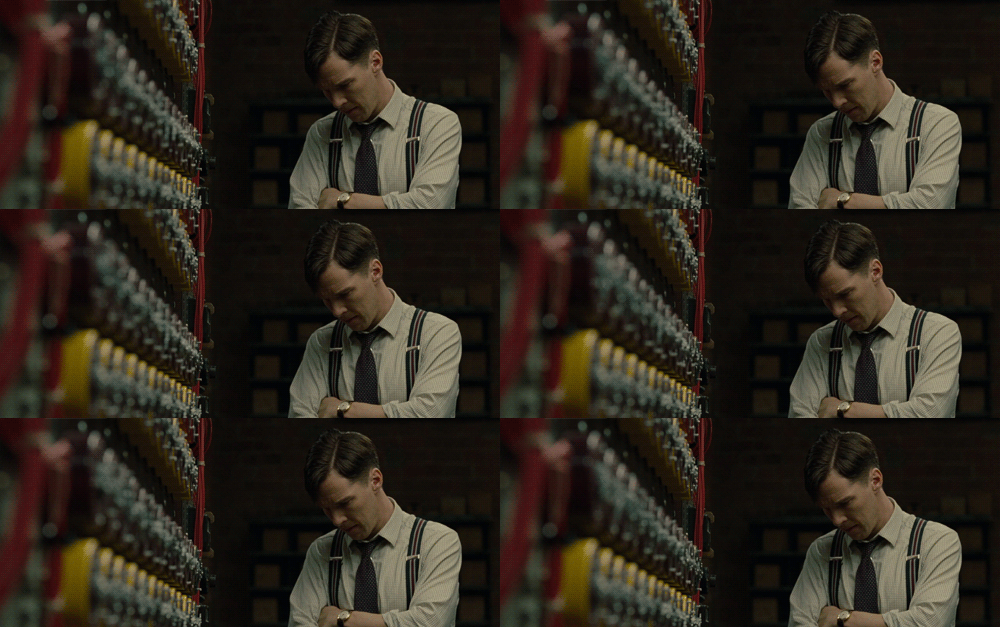
In a way what is happening in the world of Westworld is happening right now – we’re not actually building sentient robots yet, but it’s getting there.
Little Critters
This year in particular we have seen the rise of the ‘Bot’ or ‘Chatbot’. These little critters are popping up rapidly on the messenger apps like Facebook Messenger, Kik, Wechat and Slack. They are being churned out at a rate of knots by over excited developers with over 11,000 out there and rising.
Nearly all the messenger apps are starting to invest heavily in the development of chatbots and are actively encouraging and challenging developers to take on chatbot projects and build their own. To make life easier for developers they are even offering ready made templates to get them started. The enthusiasm has been infectious and some brands have already been early adopters of the technology and have started to communicate and sell products and services to their customers via a chatbot.
Exciting times

So why get all excited about chatbots? Well with more and more people using messaging apps than ever before, from a marketing point of view this is game changer. Anyone on a messenger app can now have a one on one conversation with a product, service or brand that uses a bot. With up to 2.5 billion people using messenger apps and growing it’s a massive audience and younger audiences are using message apps more than social media.
There are now bots for news, games, weather, fashion, booking holidays, financial advice and shopping. There’s even an influencer bot – so the human influencers had better watch out! There’s even a bot that can be your friend in case you have no human friends, the less said about that one the better.
Bots are not just being developed for messenger apps but for Smart Devices such as Google Assistant, Apple Siri and Amazon Echo. Where the conversations are not limited to text but in audio and using voice recognition. Mark Zuckerberg recently showcased Facebook’s Jarvis project in his own home. Google setup ‘Google Brain’ 5 years ago and are actively pursuing an AI agenda, particularly applying from what they have learnt from the development of Google Translate. Audi and Honda are also in the early stages of developing a bot for your car, or rather your car is a bot – think Knight Rider!
It’s trial and error and developers will admit they are on a very steep learning curve about getting the user experience right. In a lot of cases the conversations usually are basic, linear and structured with a very obvious list of pre-programmed questions and answers. That maybe the fault of some of the template options available. There are some bots out there were more thought has gone into giving them a bit of personality and therefore the conversation with humans appears more natural. Just interacting with a bot you get a good idea where this technology is going.
The challenge from a brand point of view, is to create bots that will engage with customers on a conversational level, to be more of helpful and natural rather than trying to ‘robotically’ sell to you. This may sound easy, but it can be quite a challenge for creatives and developers to get the balance right in the brand bot / human relationship to create a good user experience.
However like Westworld, bot developers will tell you their long term plan is to have bots learn from interacting with humans (machine learning) and therefore appear more human and therefore create a better user experience.
Such is the rate of development, within 5 years you could chat with a messenger bot like you would with anyone of your friends or family, it will have a conversation with you based on your relationship with it. That conversation would have all the bonding, banter, slang, humour, and nuances that are involved in any dialogue between two people who know each other.
How people may feel about this kind of relationship and how it could be misused remains to be seen.
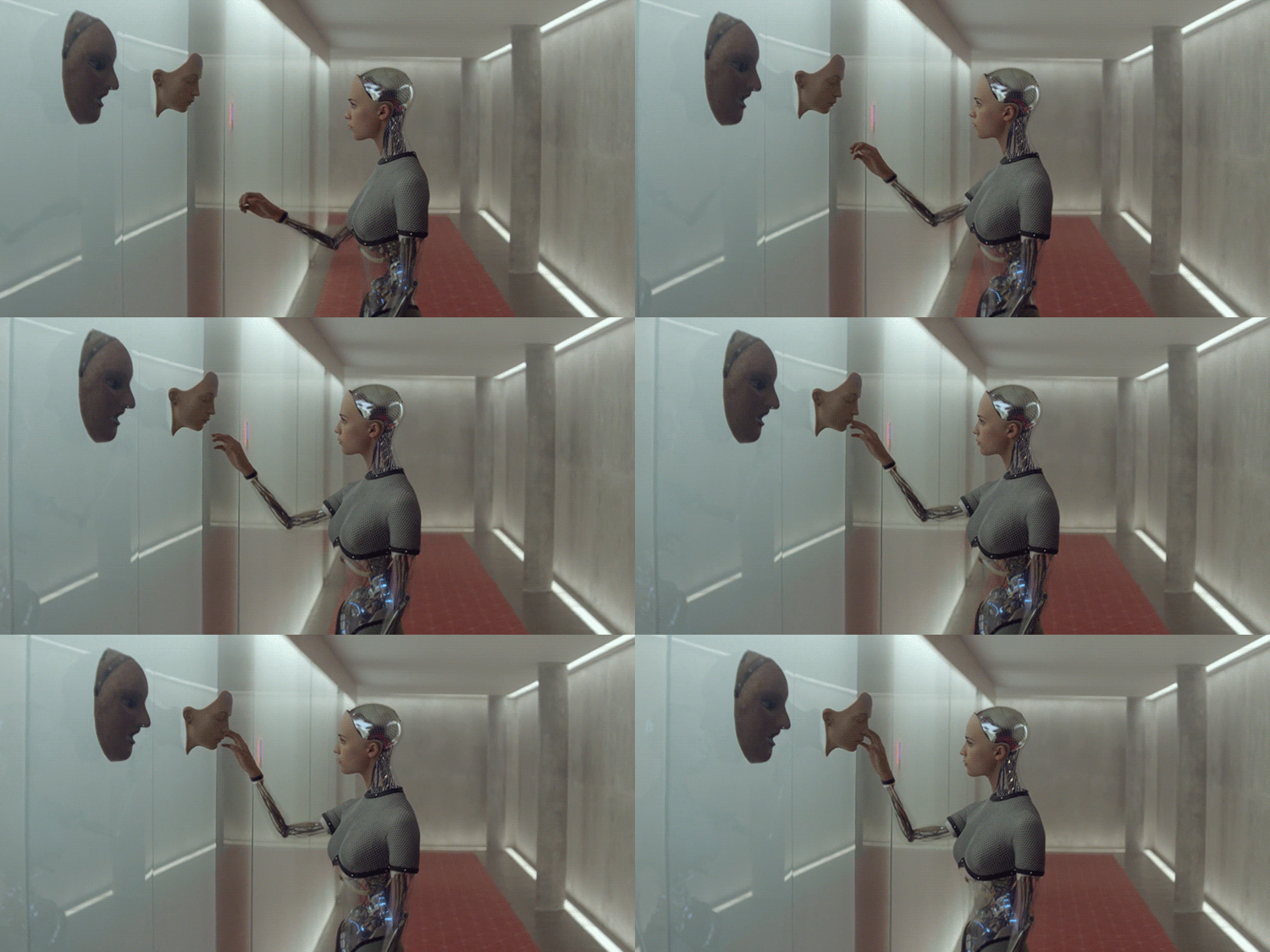
The development and application of this technology appear to be limitless and will have implications across business, politics and society. Experts have been talking about the fourth, (or fifth) industrial revolution, or the third wave of globalisation.
Maybe it’s ironic that the first AI to pass the Turing Test will be from a messenger app bot or from a smart device and not a supercomputer or Android. It looks like 2017 could be the year we see the rise of the bots.
 Art Director Nerd